

China Top 10 Ultraviolet Light Manufacturers introduces companies serving a market shaped by disinfection, curing, inspection, and specialized lighting needs. The phrase “ultraviolet light” covers different wavelength bands and applications, so products that look similar may perform very differently. A compact UV-C unit, for example, cannot be judged by its housing alone. Output, exposure distance, operating life, and test data all matter.
Safety and evidence matter, too. Columbia University radiation biophysicist David J. Brenner described far-UVC as having “the potential to be a game changer in the fight against COVID-19.” That statement concerns a specific technology and research context; it should not be treated as proof that every UV product is safe or effective. Buyers should check manufacturers’ technical documentation and use products only as directed. Small details count.
This overview compares ten China-based manufacturers through practical signals: product range, stated specifications, quality controls, customization capabilities, and available customer support. It is a starting point, not a laboratory test or a guarantee of performance. Company claims can vary in depth, and some are difficult to compare directly. That gap deserves attention. Readers should verify wavelength, irradiance, independent test results, and warranty terms before making a decision. A persuasive catalog is useful, but measured performance is better.
China’s ultraviolet light manufacturing industry spans UV-C disinfection equipment, UV curing systems, industrial inspection lamps, and ultraviolet LEDs. Factories may combine lamp assembly with quartz processing, electronic power supplies, optical testing, and thermal management. These details matter: stable output depends on more than a lamp’s rated wattage. Buyers should check wavelength, irradiance at a stated distance, operating life, and test conditions.
Fortune Business Insights estimated the global UV disinfection equipment market at about US$5.4 billion in 2023 and forecast roughly US$11.4 billion by 2032. MarketsandMarkets projected the global UV LED market to rise from US$1.2 billion in 2023 to US$2.5 billion by 2028.
These figures indicate demand, not China’s market share. That distinction is easy to miss. China’s manufacturing base benefits from dense electronics and component supply chains, but public estimates rarely separate domestic production from exports or distinguish lamp technologies consistently. The numbers are not perfectly comparable.
For sourcing, factory-level evidence is more useful: request spectral test records, aging data, and clear measurement methods. A polished specification sheet helps, but it cannot replace independent testing.
Assessing ultraviolet light manufacturers in China requires more than comparing quoted prices. Define the required wavelength, output, operating hours, and installation conditions before contacting suppliers. A unit designed for one process may perform poorly in another. Small details matter.
Ask how each manufacturer measures wavelength and irradiance. Request recent test records, instrument calibration details, and output-uniformity data across the working area. These figures help distinguish measured performance from catalogue claims. Check how heat affects output and whether performance changes during extended operation. If possible, test a production sample under conditions similar to your own. A brief demonstration may hide variation.
Review manufacturing controls, component traceability, inspection procedures, and warranty terms. Ask how rejected units are handled and whether replacement parts remain available. A polished brochure is not proof. I would not treat certificates alone as evidence of consistent quality; their scope and date matter. Compare the sample with later production units, since small differences can appear between batches. Clear technical answers, documented checks, and realistic delivery commitments provide a stronger basis for evaluation than low cost alone.
| # | Assessment Dimension | What to Verify | Evidence / Evaluation Benchmark | Weight | Score (0–5) |
|---|---|---|---|---|---|
| 1 | Wavelength and UV technology | Confirm the UV band and source technology offered for the intended application. | Request a product-specific spectral or wavelength report. Common UV bands are UV-A (315–400 nm), UV-B (280–315 nm), and UV-C (100–280 nm); check the applicable specification and measurement method. | 15% | ___ / 5 |
| 2 | Irradiance and dose data | Check whether output is measured at a stated distance, position, and operating condition. | Request irradiance data (for example, mW/cm²) and the measurement setup. For a stated exposure period, UV dose is calculated as irradiance × time and is commonly expressed in mJ/cm². | 14% | ___ / 5 |
| 3 | Application efficacy validation | Assess test results for the actual use case, such as water, air, or surface treatment. | Ask for test conditions, target organism or material, exposure time, test method, and independent laboratory results where available. Do not treat efficacy claims as universal across different conditions. | 12% | ___ / 5 |
| 4 | Product safety and risk controls | Review controls that reduce exposure risks, especially for UV-C products. | Check shielding, interlocks, motion or door sensors where relevant, warning labels, operating instructions, and product-specific safety test reports. Ask whether photobiological safety was assessed against applicable requirements, such as IEC 62471 where relevant. | 10% | ___ / 5 |
| 5 | Quality management and traceability | Verify the quality system, production controls, and ability to trace supplied products. | Check the validity and scope of any ISO 9001 certificate, batch or serial-number traceability, incoming inspection records, and documented final testing. A certificate alone does not establish product performance. | 10% | ___ / 5 |
| 6 | Electrical and market compliance | Determine whether the exact product configuration meets requirements in the destination market. | Request applicable declarations, test reports, and certificates for the intended market and model. Confirm that product name, model, components, and report scope match the items being quoted. | 9% | ___ / 5 |
| 7 | Reliability and service life claims | Review how output, component life, and maintenance needs are specified and tested. | Ask for test conditions, rated operating hours, output-maintenance data, replacement intervals, and warranty terms. Distinguish lamp or LED component life from the lifetime of the complete device. | 8% | ___ / 5 |
| 8 | Customization and engineering support | Assess the supplier’s ability to adapt the product to required dimensions, controls, power, or installation conditions. | Request drawings, interface specifications, prototype procedures, change-control records, and confirmation of which custom features are included in compliance testing. | 8% | ___ / 5 |
| 9 | Production capacity and delivery control | Check whether production planning and inspection can support the required quantity and schedule. | Ask for a capacity statement, typical lead-time assumptions, production quality checkpoints, packaging details, and how schedule changes or shortages are communicated. | 7% | ___ / 5 |
| 10 | Documentation and after-sales support | Evaluate the completeness of technical documents and the process for handling service requests. | Review manuals, datasheets, installation guidance, spare-parts availability, warranty procedures, response channels, and troubleshooting support in the required language. | 7% | ___ / 5 |
| Total weight | 100% | — | |||
Profiles of ten leading Chinese UV light manufacturers reveal a varied industry, not one standard product. Some focus on quartz-tube lamps for water treatment, while others make UV-C units for air systems or surface disinfection. Several specialize in UV-LED modules, valued for compact size and quick switching. Industrial curing equipment is another distinct field, with output matched to inks, coatings, and production speed. These differences matter. A lamp designed for a water channel may not suit a packaging line.
When comparing manufacturers, examine more than advertised wattage. Ask for spectral data, irradiance measurements, lamp-life conditions, and test methods. Check whether the company builds complete systems or supplies components only. The ten profiles should also be judged by engineering support, customization options, and consistency between sample units and larger orders. Small details count: connector type, cooling design, and the distance between lamp and target can affect performance. A polished specification sheet is useful, but it is not proof by itself.
Tips: Request a recent test report and clarify how results were measured. Confirm replacement-part availability and operating conditions in writing. If possible, evaluate a sample in your own setup. One caution: public product information can be incomplete, and “top” rankings may use different criteria. Verify claims directly before making a purchasing decision.
China Top 10 Ultraviolet Light Manufacturers
UV Technologies and Products Offered by Chinese Manufacturers
Chinese manufacturers offer ultraviolet products for water treatment, air handling, surface processing, and industrial curing. Common options include low-pressure mercury lamps, UV-C LED modules, quartz sleeves, electronic power supplies, and assembled disinfection reactors. A conventional lamp often operates near 254 nanometers; UV-C LEDs provide compact alternatives, commonly within the 265–280-nanometer range. Product choice depends on the target application. A clear-water reactor, for example, needs controlled flow and sufficient exposure, not merely a powerful lamp. Small details matter.
MarketsandMarkets’ UV Disinfection Equipment Market report estimated a market value of US$4.5 billion in 2022 and projected US$8.1 billion by 2027. That forecast points to growing demand, but it does not guarantee performance for any individual device. Buyers should compare measured UV dose, flow rate, lamp life, power use, and maintenance access. For air systems, airflow and installation affect exposure; for water systems, turbidity can reduce treatment effectiveness. Specifications can look impressive on paper. They may still leave practical questions unanswered, such as how output changes as a lamp ages. Requesting test conditions and independent performance data makes comparisons more meaningful.
Ultraviolet lighting serves different tasks, and each needs a defined exposure dose. In water treatment, UV-C systems can disinfect flowing water without adding chemicals. The World Health Organization’s 2011 evaluation of household water-treatment technologies uses a UV dose benchmark of 40 mJ/cm² for high-level pathogen reduction. Actual performance depends on water clarity, flow rate, and lamp output. Cloudy water can shield microorganisms.
In buildings, upper-room UV-C can help reduce airborne microbes when airflow and fixture placement are properly designed. Surface systems are used in controlled rooms, while UV-A supports some curing and inspection processes. Measure output at the working distance. Check it again as lamps age. Small details matter. IEC 62471 sets photobiological safety requirements for lamps and lamp systems, including ultraviolet sources. For drinking-water equipment, NSF/ANSI 55 provides performance and safety criteria for UV microbiological treatment systems. Buyers should also check dose monitoring, shielding, access interlocks, and maintenance records. A bright lamp is not proof of a safe or effective installation. I would still question any claim that ignores room geometry or water quality.
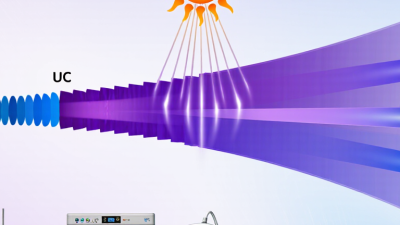
The chart shows the CIE wavelength bands for ultraviolet radiation. UV-A is commonly used for curing and inspection, UV-B for applications such as phototherapy, and UV-C for disinfection. These are broad application examples, not product performance claims. Photobiological safety assessment for lamps and lamp systems is addressed by IEC 62471.