How to Choose Industrial Lighting for Your Facility
Choosing industrial light is not simply a matter of replacing old fixtures with brighter ones. A good plan starts with the work: workers may inspect fine details, move materials, or operate equipment in changing conditions. Each task calls for appropriate illumination, distribution, and glare control. Lighting researcher Dr. Mark Rea has used the phrase, “Light is a drug.” It is a useful reminder that light affects people, though it is not a fixture-selection rule. In a facility, decisions also affect visibility, comfort, energy use, and maintenance.
Start by examining the space. Note ceiling height, dusty or damp areas, operating hours, and the location of work surfaces. Then compare fixture output, color quality, controls, and expected service life. Check how light reaches aisles and benches, not just the floor below each fixture. Measure existing conditions where possible, and ask a qualified lighting professional to verify the design against relevant recommendations. Small details matter. A bright fitting can still leave shadows on a workbench. A lower-cost option may also require more frequent maintenance; the numbers deserve a careful look.
This guide explains how to assess needs, compare technologies, and plan installation around real operating conditions. It also considers trade-offs that product pages often simplify. No single specification tells the whole story. I would still revisit assumptions after installation, because actual work patterns rarely match a perfect drawing.
Assess Work Tasks and Set Lux Targets Using ANSI/IES RP-7-21
Industrial lighting should begin with the work, not the fixture.
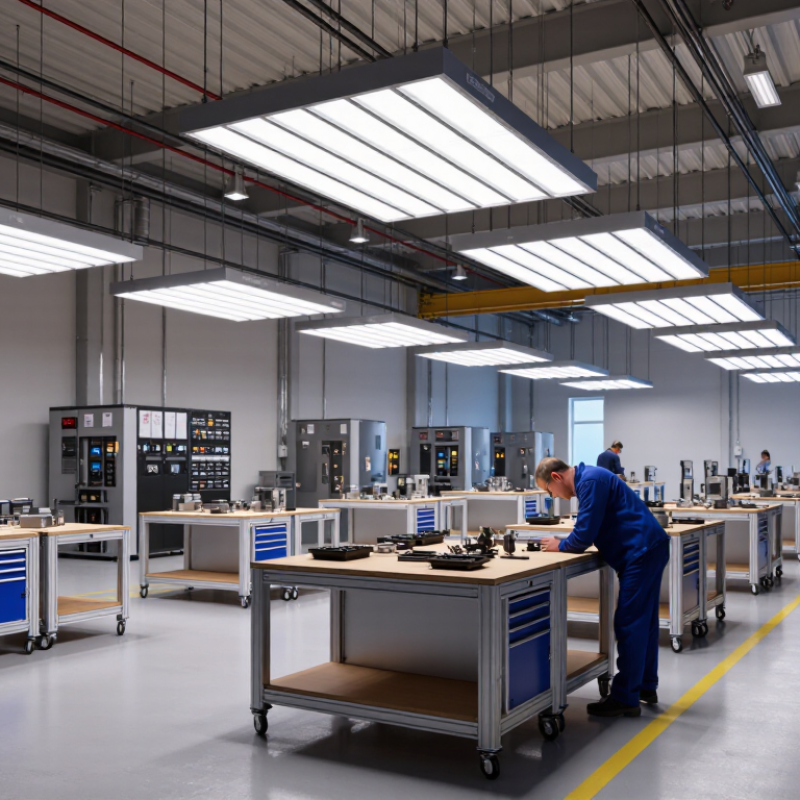
ANSI/IES RP-7-21, Recommended Practice: Lighting Industrial Facilities (2021), guides users to consider visual tasks, operating conditions, and maintained illuminance. A warehouse aisle and a bench where staff inspect small markings need different targets. As a planning screen, teams often compare about 200–300 lux for general movement and 500 lux for detailed inspection; confirm task-specific values against the practice and applicable requirements. Measure lux on the actual work plane, not only at floor level.
Tips: Record the task, surface, and measurement point. Check readings with machinery running, and include shadows from shelving or overhead equipment. Recheck after dust builds up.
A lux meter can reveal a bright room with dim work surfaces. That is easy to miss on a drawing. Note the lowest readings near machine controls, labels, and inspection points, then compare them with the chosen target. RP-7-21 also supports evaluating uniformity and glare, since a high average can hide dark patches or uncomfortable reflections. Keep a short log of readings and conditions; repeat measurements after layout changes or maintenance. The first survey may be imperfect, especially around moving equipment, so mark uncertain locations and revisit them during normal shifts.
Check OSHA’s 5-fc Minimum for Construction Warehouses (29 CFR 1926.56)
For construction work covered by OSHA’s 29 CFR 1926.56, warehouses, corridors, hallways, and exitways require at least 5 foot-candles of illumination. That is about 54 lux. The requirement is a minimum, not a guarantee that every task will be easy to see. A worker reading small labels on a high shelf may need more light than someone walking through an open aisle. The standard also does not mean every industrial facility, regardless of its work, has the same lighting needs.
Check actual light levels where people work, not just the fixture specifications. A handheld light meter can help; take readings along aisles, near shelving, and at loading areas. Watch for dark patches beneath racks and glare reflected from polished floors or metal surfaces. A bright fixture can still leave a shadow on a workbench. Keep lenses clean and replace failed lamps, then recheck after equipment or storage layouts change. One reading may look fine on paper while a worker still struggles to read a label. That gap deserves attention. OSHA’s 5-fc threshold is a useful compliance check, but task visibility and safe movement should guide the broader lighting plan.
Compare LED Energy Use with DOE’s 75%-Lower Benchmark vs. Incandescent
The U.S. Department of Energy says LED bulbs use at least 75% less energy than incandescent bulbs. Treat that as a comparison benchmark, not a promise of 75% savings across your facility. Actual results depend on the lamps being replaced, operating hours, controls, and required light levels.
Start with a fixture count and wattage check. If a suitable 15-watt LED replaces a 60-watt incandescent, each fixture draws 45 fewer watts. Across 100 fixtures running 4,000 hours yearly, that difference equals about 18,000 kilowatt-hours annually. Check that the replacement also delivers enough light for the task. A spreadsheet can miss a dim loading bay.
In production areas, compare measured light levels at work surfaces before and after installation. Note glare, shadows, and uneven illumination near machinery or aisle corners. LEDs may also reduce relamping needs, but lifetime depends on heat, dust, vibration, and driver quality. I would question any estimate that assumes every fixture runs equally long. Record actual schedules, then compare utility use after installation.
Match Fixture IP/IK Ratings and UL 1598 Listings to Facility Hazards
Start with the actual hazards at each fixture location, not a generic “industrial” label. A washdown bay, dusty grain room, and forklift aisle need different protection. IEC 60529 defines IP ratings for dust and water ingress; IP66, for example, indicates dust-tight construction and protection against powerful water jets. It does not establish impact resistance. IEC 62262 rates mechanical impact: IK08 represents 5 joules, while IK10 represents 20 joules. Match the rating to likely exposure, such as hose spray or a bumped guard. The U.S. Bureau of Labor Statistics reported 2.6 million nonfatal workplace injuries and illnesses in private industry in 2023. That figure is not lighting-specific, but it is a useful reminder that everyday site conditions deserve attention.
Check the exact luminaire’s UL 1598 listing, installation instructions, and mounting method. A listing supports compliance with the standard’s luminaire safety requirements; it does not automatically prove suitability for every hazardous location or unusual installation. Verify that seals, lenses, and guards remain intact after maintenance. A high IP rating cannot make a weak mounting bracket impact-proof. Nor does an IK rating promise protection from chemical corrosion. Walk the site and note where water, dust, vibration, and vehicle contact occur. A tidy specification sheet can still miss the real hazard. That part takes judgment.
Plan Lighting Controls and Verify Performance After Installation
Industrial lighting should work with the way a facility operates, not just meet a target on paper. Before installation, map control zones around work areas, aisles, storage racks, and spaces with daylight. Set occupancy sensors to suit actual movement; a sensor that switches off too quickly can interrupt careful work. Plan dimming levels and manual overrides, too. Simple controls are often easier to maintain.
Tips: Test one representative zone before applying settings across the facility. Check sensor coverage from floor level, including behind tall racks and near doorways. Small blind spots matter.
After installation, measure illuminance at the work surface with a calibrated light meter. Take readings at several points, not just beneath a fixture, and compare them with the project’s lighting criteria. Test occupancy response, daylight dimming, and manual controls during normal operations. Record settings and readings so maintenance staff can spot changes later. Check for glare, uneven patches, and unwanted switching during a full shift. Numbers can look fine while operators still struggle to read labels. Adjust carefully, then retest. One thing teams sometimes miss: furniture, stored materials, and dust can change how light reaches a task area. Performance checks are not a one-time formality.