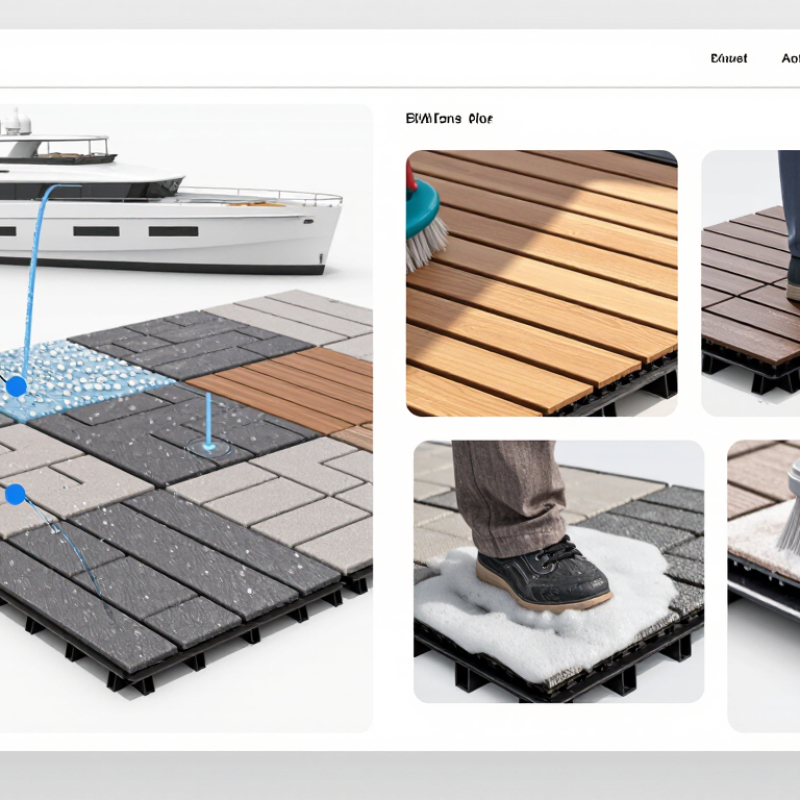
Choosing the 2026 best Eva Deck Flooring requires more than comparing colors, prices, or attractive product photos. Global buyers must examine foam density, closed-cell structure, UV resistance, saltwater performance, and adhesive stability. A deck may look flawless in a showroom, yet soften under tropical heat or lift around a poorly prepared edge.
Marine flooring specialist David McKenzie states, “The best Eva Deck Flooring balances comfort, traction, durability, and installation discipline.” That practical view matters. Buyers should request technical data, production samples, colorfastness information, and realistic warranty terms before placing large orders. A sample should be tested with wet footwear, direct sunlight, cleaning chemicals, and repeated foot traffic. Small details matter.
The strongest products usually provide a firm walking surface without feeling harsh under bare feet. Their texture should drain water effectively, especially around seating areas, swim platforms, and cockpit steps. Adhesive quality also deserves close attention. Moisture, dust, and uneven substrates can weaken even premium materials.
No product wins every test. That is worth remembering. Thicker foam may improve comfort, but it can complicate cutting and edge finishing. Dark colors often appear elegant, but they may become hotter under intense sunlight. Light colors feel cooler, yet stains can show sooner. These trade-offs make product selection less simple than many buying guides suggest.
This guide compares leading Eva Deck Flooring options for distributors, boat builders, yacht owners, and outdoor equipment manufacturers. It focuses on measurable performance, practical installation, maintenance demands, and long-term value across different climates. Evidence should lead the decision. Marketing claims alone are not enough.
EVA deck flooring is a lightweight, cushioned surface used on boat decks, swim platforms, and outdoor work areas. EVA means ethylene-vinyl acetate, a flexible polymer with useful shock absorption and water resistance. It feels softer than fiberglass or aluminum underfoot. That matters during long hours on a moving deck.
Most EVA flooring uses closed-cell foam. Tiny sealed cells limit water absorption and improve buoyancy, although no material remains perfect after years of cuts and compression. A textured top layer provides traction, while grooves or laser-cut patterns help guide surface water away.
The underside may include pressure-sensitive adhesive or a separate bonding layer. Core materials usually include EVA resin, color pigments, UV stabilizers, and processing additives. Density and hardness change the balance between comfort, durability, and grip.
Tips: Check the foam density, thickness, peel strength, and water absorption data before buying. Ask for samples. Walk on them with wet footwear. Inspect the edge after trimming, because weak edges can lift early. For global projects, request technical sheets and testing records for UV exposure, dimensional stability, and adhesive performance. Color can also vary between production batches, a small detail that is easy to overlook. A darker surface may feel hotter in direct sun, while a very soft foam can show dents from heavy equipment. Selection is rarely perfect; the right structure depends on climate, deck material, traffic, and maintenance habits.
Comparing EVA deck flooring requires more than checking thickness or color. Start with foam density, cell structure, and surface hardness. Closed-cell EVA should resist water absorption and maintain cushioning after repeated use. Ask for technical data, not attractive photographs. A reliable supplier should provide test results for tensile strength, abrasion resistance, UV exposure, and compression recovery. These figures reveal more than marketing language.
Surface traction matters when decks are wet, dusty, or covered with sunscreen. Check the texture with wet footwear and bare hands. A pattern that feels aggressive indoors may become uncomfortable during long trips. Examine edge cuts, seams, and backing adhesion closely. Poorly bonded layers can lift around corners after heat, salt, and cleaning. Leave room for expansion.
Installation conditions also affect performance. The deck must be clean, dry, and properly prepared. Measure temperature limits for both the material and adhesive. I have seen good foam fail because installers rushed surface preparation. That mistake is easy to repeat. Request samples and test them under local sunlight, water, and foot traffic before placing a large order. Compare color stability, odor, flexibility, and cleaning response over several weeks. No single number tells the whole story. Some evaluations still miss real-world wear. That is why documented testing and practical trials should support each other.
For global marine buyers, the best EVA deck flooring depends on the vessel’s working conditions. A closed-cell EVA foam sheet suits yachts and cruising boats because it feels soft under bare feet. It also resists water absorption during regular use. A thinner, embossed surface can work well around cabin entrances and narrow walkways. It offers grip without adding excessive weight.
Fishing boats need a tougher choice. High-density EVA with a brushed or embossed texture handles wet footwear, bait residue, and frequent cleaning. Dark colors may hide stains, but they can become hot under strong sunlight. Pontoons and swim platforms often benefit from thicker foam with strong cushioning. The extra comfort matters when passengers step from water onto a hard surface. It must also bond securely to aluminum, fiberglass, or painted decks.
Preparation decides more than many buyers expect. I have seen good flooring fail because installers left dust, wax, or moisture beneath the adhesive. The deck should be clean, dry, and lightly prepared according to the adhesive instructions. Measure curved edges carefully. Small gaps can collect salt and dirt. Self-adhesive flooring saves time, but it is not automatically suitable for every climate. Extreme heat, cold storage, and constant spray can expose weak adhesion. A thicker pad is not always better. It may create raised edges or interfere with hatches. Marine flooring selection should match traffic, surface temperature, cleaning habits, and installation skill.
2026 Best EVA Deck Flooring for Global Buyers
Global buyers should compare EVA deck flooring by size, density, surface texture, and adhesive compatibility. Common sheet sizes include 2400 × 900 mm and 2400 × 1200 mm. Smaller panels can reduce waste around curved seats and hatches. Measure the deck twice, especially near corners and drainage channels.
Color affects both appearance and heat absorption. Light gray, sand, and pale blue usually feel cooler under strong sunlight. Dark tones can highlight clean lines but may become hot in tropical climates. Color samples are useful, yet screens often distort them. A perfect match is rare. Request a physical sample before ordering large quantities.
Installation needs a clean, dry, grease-free surface. Use a sharp template knife for tight edges, and leave no trapped air beneath the sheet. Apply compatible marine adhesive evenly, then press the flooring with a weighted roller. Temperature matters. Cold conditions can reduce bonding strength, while excessive heat may stretch the material. Allow proper curing time before use.
For maintenance, rinse away salt, sand, and fish residue after each trip. Use mild soap and a soft brush. Avoid harsh solvents, wire brushes, and high-pressure spray at close range. Inspect lifting edges every few weeks. Small failures are easier to repair early. In practice, buyers sometimes focus on color and overlook drainage, replacement access, or local shipping conditions. Those details can affect the flooring’s real service life.
Global Buyer Guide to Sizes, Colors, Installation, and Maintenance
The chart compares representative EVA deck sheet formats by coverage area. Larger sheets can reduce seams on broad surfaces, while smaller tiles are easier to handle around curves, hatches, and complex layouts. Always confirm finished dimensions, tolerances, adhesive type, and packaging requirements with the supplier before ordering.
Common formats range from compact 600 × 600 mm pieces to large 2400 × 1200 mm sheets. Select the format according to deck layout, seam visibility, and shipping efficiency.
Black, gray, light gray, brown, and teak-style tones are widely used. Darker colors generally conceal dirt better, while lighter colors can make a deck look more spacious.
Clean, degrease, and completely dry the surface before templating and applying the adhesive-backed EVA material. Use a roller to improve contact and follow the adhesive curing instructions.
Rinse with fresh water and clean with mild soap and a soft brush. Avoid harsh solvents, strong bleach, sharp tools, and aggressive pressure washing that may damage the surface or adhesive.
EVA deck flooring in 2026 should be judged beyond color, thickness, and price. International buyers need documented performance for their target market. Check density, compression recovery, UV resistance, water absorption, and slip resistance. A 6 mm sheet may feel soft, yet it can compress quickly under coolers or seat bases.
Safety depends on testing and installation. Request current reports for material composition, VOC emissions, flame behavior, and surface traction. Requirements differ between countries and vessel categories, so confirm them with an independent laboratory or local compliance adviser. Ask whether testing covers the finished flooring, not only raw EVA foam. Adhesive choice matters too. A strong foam can fail when the glue softens under deck heat.
Inspect a production sample under sunlight, moisture, and foot traffic. Measure thickness at several points. Small variations often reveal weak process control. Request batch numbers, inspection photos, packing details, and a clear replacement policy before payment. Compare shipping terms, carton protection, import documents, and realistic lead times. Samples can mislead. I would also test edge cutting and residue removal, because installation problems are expensive to correct overseas. A lower unit price is not a lower total cost. Less obvious issues deserve attention.
| Evaluation Dimension | Recommended 2026 Buying Benchmark | Relevant Test or Reference | Safety and Performance Significance | International Purchasing Check |
|---|---|---|---|---|
| Material composition | Closed-cell EVA foam with uniform coloration and consistent cell structure; avoid unexplained filler content or strong persistent odor. | Supplier material declaration; ISO 845 for cellular-material density; laboratory composition verification when required. | Closed cells reduce water uptake and help maintain buoyancy, cushioning, and dimensional stability. | Request a technical data sheet, safety data sheet where applicable, and a retained production sample. |
| Typical thickness | 5–6 mm for general deck coverage; 8–10 mm where greater cushioning, noise reduction, or surface leveling is required. | Dimensional inspection using calibrated thickness gauges; tolerance to be agreed in the purchase specification. | Thicker material can improve comfort but may increase edge lifting, adhesive consumption, and installation height. | Define nominal thickness, permitted tolerance, roll or sheet format, and allowable thickness variation. |
| Apparent density | Approximately 90–180 kg/m³ for lightweight marine-deck applications, subject to the required hardness and compression performance. | ISO 845 or ASTM D3575 density-related procedures, as applicable to the foam construction. | Density affects weight, resilience, compression resistance, machining behavior, and cost. | Compare density on the same thickness basis and require batch-to-batch tolerance limits. |
| Hardness and underfoot comfort | Common purchasing range: approximately 25–60 Shore C, with harder grades generally better for high-traffic areas and softer grades better for comfort. | ASTM D2240 or an equivalent agreed hardness method; test temperature and specimen conditioning should be recorded. | Hardness alone does not establish slip resistance, durability, or suitability for concentrated loads. | Approve a physical sample and specify the acceptable hardness range rather than relying only on a nominal grade. |
| Compression resistance | Use a grade that maintains shape under expected foot traffic, seating loads, hatch covers, and equipment contact; obtain the supplier’s stress–strain data. | ISO 3386-1 or ASTM D3575, selecting the method appropriate to the foam type. | Insufficient compression resistance can cause permanent dents, telegraphing, and premature visual wear. | Ask for compression set and stress–strain results at a defined temperature and loading condition. |
| Wet slip performance | Require a textured or grooved surface and documented wet-slip test results; do not approve a product based on texture appearance alone. | ASTM E303 pendulum testing or EN 13893 where applicable; the selected test must match the intended footwear and wet-use condition. | Slip resistance depends on water, oil, footwear, surface pattern, contamination, and test direction. | Request wet and contaminated-surface results, test conditions, specimen orientation, and any stated limitations. |
| UV and weather resistance | Use UV-stabilized material for exposed decks and require evidence of color, flexibility, and adhesion retention after accelerated weathering. | ASTM G154 or ISO 4892-3 accelerated weathering methods, with exposure cycle and evaluation criteria specified. | UV exposure can cause fading, embrittlement, surface cracking, and loss of adhesive performance. | Do not treat accelerated-weathering hours as a direct service-life guarantee; request regional outdoor-use references. |
| Water and chemical resistance | Closed-cell construction with low water absorption; verify compatibility with saltwater, mild detergents, fuel splash, sunscreen, and cleaning chemicals. | Supplier immersion and chemical-resistance testing using the buyer’s actual exposure conditions. | Chemical swelling or softening may reduce slip performance and cause adhesive or edge failure. | Provide the intended cleaning agents and request written compatibility confirmation before mass production. |
| Surface texture and drainage | Use a texture that drains water without creating sharp edges or dirt traps; specify groove direction, depth, and repeat pattern. | Visual inspection, wet-slip testing, drainage evaluation, and dimensional inspection of the embossed pattern. | Pattern design influences traction, cleanability, drying time, and long-term appearance. | Approve a full-size sample because small swatches may not reveal pattern alignment or drainage behavior. |
| Fire and smoke requirements | Treat fire performance as project-specific; obtain a test report for the exact thickness, construction, adhesive, and surface finish. | Applicable marine, building, or vehicle fire regulations; a general foam certificate is not sufficient for every installation. | Fire behavior can change significantly with thickness, backing, adhesive, and installation substrate. | Confirm the importing country, vessel classification, flag-state, and project authority requirements before ordering. |
| Dimensional stability | Require stable sheet or roll dimensions after conditioning, with clearly defined length, width, thickness, and squareness tolerances. | Conditioned dimensional inspection; compare results before and after heat and humidity exposure where relevant. | Shrinkage or expansion can open seams, distort patterns, and create trip edges. | Specify acclimatization time, storage temperature, roll direction, and installation temperature. |
| Adhesive compatibility | Select an adhesive system compatible with EVA, the deck substrate, moisture exposure, temperature range, and expected movement. | Adhesive manufacturer’s technical data, peel or shear testing, and project-specific mock-up evaluation. | A suitable foam can still fail through bubbling, edge curl, delamination, or inadequate cure. | Purchase adhesive and flooring as a validated system when possible; document surface preparation and cure time. |
| Color and appearance consistency | Define color tolerance, grain direction, surface finish, joint appearance, and acceptable visual defects before production. | Approved limit sample, controlled lighting inspection, and agreed defect classification. | Color variation and pattern mismatch are common causes of rejection even when technical properties pass. | Use a signed golden sample and retain pre-shipment photographs linked to the production batch. |
| Packaging and shipping protection | Protect surfaces from compression marks, moisture, dust, heat, and prolonged roll deformation during transport. | Packaging inspection; confirm carton or pallet dimensions, net weight, gross weight, and storage instructions. | Poor packaging can create permanent creases, contamination, and installation defects before the product reaches the site. | Confirm Incoterms, moisture protection, pallet treatment requirements, shipping marks, and container loading limits. |
| Quality-control documentation | Require batch identification, inspection records, test reports, approved samples, and a traceable certificate of conformity. | Inspection plan agreed before production; independent pre-shipment inspection for high-value or critical projects. | Traceability supports complaint handling, corrective action, and consistent repeat orders. | Make documentation, sampling level, defect limits, and corrective-action timing part of the purchase contract. |